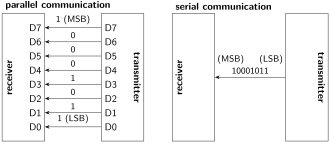
Serial communication occurs when information is sent one bit at a time over a single wire. This is in contrast to parallel communication where information is sent all bits at once, each bit having its own dedicated wire. Serial communication therefore can cause a reduction in the number of wires required to transmit and receive information. The schematic difference between serial and parallel communication is shown in Figure 10.0.1. In this diagram, each transmitter sends 8 bits of data to the receiver.
While parallel data transmission allows many bits to be sent simultaneously, it requires as many wires as bits. This can be prohibitive in a microcontroller as the number of I/O ports is quite limited. In addition, parallel I/O can suffer from noise known as crosstalk which occurs when electromagnetic interference between neighboring wires causes signal levels to change unexpectedly.
With serial communication, data is sent one bit at a time. Using as few wires as possible minimizes crosstalk. There are many features of serial communication that may change the configuration and number of wires required to implement the communication protocol.