Skip to main content
Contents Dark Mode Prev Up Next \(\newcommand{\N}{\mathbb N} \newcommand{\Z}{\mathbb Z} \newcommand{\Q}{\mathbb Q} \newcommand{\R}{\mathbb R}
\newcommand{\lt}{<}
\newcommand{\gt}{>}
\newcommand{\amp}{&}
\definecolor{fillinmathshade}{gray}{0.9}
\newcommand{\fillinmath}[1]{\mathchoice{\colorbox{fillinmathshade}{$\displaystyle \phantom{\,#1\,}$}}{\colorbox{fillinmathshade}{$\textstyle \phantom{\,#1\,}$}}{\colorbox{fillinmathshade}{$\scriptstyle \phantom{\,#1\,}$}}{\colorbox{fillinmathshade}{$\scriptscriptstyle\phantom{\,#1\,}$}}}
\)
Chapter 6 Analog to Digital Conversion
Objectives
Introduce the concept of analog to digital conversion.
Describe analog to digital converter architectures.
Introduce the analog to digital converter on the ATmega328P.
As will be discussed in
Chapter 7 , many sensors output analog values. Analog sensors include:
Potentiometers
Microphones
Temperature sensors
Photodiodes
Photoresistors
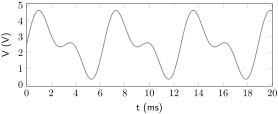
The voltage values of an analog signal can take on any real number between some minimum and maximum voltage. An example of an analog (continuous) signal is shown in
Figure 6.0.1 . This textbook will consider the minimum voltage to be ground and the maximum voltage to be equal to a reference voltage (
\(V_{ref}\) ).
Figure 6.0.1. An analog signal takes on continuous values and contains an infinite number of points.