Section 7.3 Mitigating Fluctuating Data and Sensor Noise
Sensor data can fluctuate over time due to environmental conditions or noise. It may be important to perform a rolling average to obtain a steady, reliable readout. A rolling average uses \(n\) previous values (stored in an array) to calculate the current average value. Care must be taken in choosing an appropriate value for \(n\text{,}\) which must be specifically tailored to each different sensor and situation in which it is to be used. If \(n\) is small,
-
less data memory is needed to store sensor values,
-
the program will require less time to initialize, and
-
the output value will be more susceptible to sensor noise.
If \(n\) is large,
-
more data memory is needed to store sensor values,
-
the program will require more time to initialize,
-
the output value will be less susceptible to sensor noise, and
-
if \(n\) is too large, the output will not be sensitive to short-term or quick changes in sensor values.
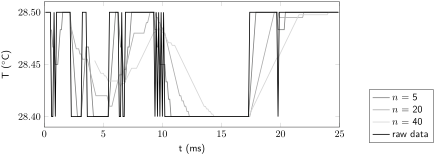
Sensor data from a temperature sensor that has been averaged out using three different values of \(n\) (as well as the raw data, which has an \(n\) value of 1) is shown in Figure 7.3.1.
Subsection 7.3.1 Circular Buffer
A circular buffer is a method of taking a rolling average to clean up sensor noise and fluctuations. It is simply an array of \(n\) sensor values, where the first value in is also the first value out. (This type of situation is known as FIFO: first in first out.) A sample array of data is shown in Figure 7.3.2 to depict this process.
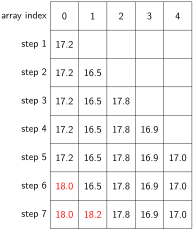
The data in the circular buffer can be pointed to in a subroutine and averaged to determine the average over the given timespan.
Subsection 7.3.2 Timed Updates
Instead of retrieving continuous updates from the sensor, the sensor value can be updated only at finite, regularly spaced intervals of time. This can be accomplished using timed interrupts. The concept of interrupts is explained in Chapter 8, and the timer/counter units are explained in Chapter 9.
For maximum noise filtering, this method can be combined with the circular buffer method.

