Section 6.1 Principles of Operation
Analog values must be converted into digital values in order to work with the digital functionality of a microcontroller. This is accomplished with an analog to digital converter (ADC). A single-ended ADC will convert a single analog signal into a digital value. A differential ADC will convert the difference between two analog signals to a digital value. [16.19] This textbook will consider single-ended analog to digital conversion (ADC).
The resolution of an ADC relates to the number of bits of binary used to store the result. This value also relates to the number of possible voltage values that can be differentiated between. An \(n\)-bit ADC can differentiate between \(2^n\) different binary values. In this manner, the resolution of an ADC will define the step size (\(\Delta V\)), which is the minimum change in voltage required to change the output value. The step size is defined by (6.1.1).
\begin{equation}
\Delta V = \frac{V_{ref}}{2^n}\tag{6.1.1}
\end{equation}
To convert an analog voltage signal into digital values, the analog signal must be sampled, quantized, and encoded.
Subsection 6.1.1 Sampling
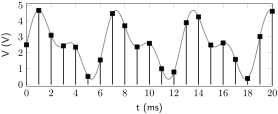
An infinite number of points can’t be digitized by a microcontroller because it would require infinite processing power and infinite memory. Therefore, the analog signal must be sampled periodically. This sample rate is very important when doing signal processing (audio, video, etc.). It is inversely related to conversion accuracy. The fine details of sampling rate are beyond the scope of this course; you will very likely study the topic in a signals and systems electrical engineering course. Figure 6.1.1 shows the analog signal from Figure 6.0.1 sampled every millisecond. At each point in time, the sampled data is held in memory and then quantized and encoded.
Subsection 6.1.2 Quantization
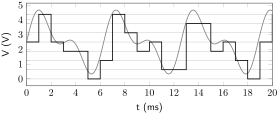
Because digital data cannot take on a continuum of values, the sampled analog data must be set equal to one of a number of discrete values. Figure 6.1.2 shows an analog signal that has been quantized. At every sampled point in the signal, that value is rounded down to the nearest possible value of \(V_{ref} \div 2^n\text{,}\) where \(n\) refers to the number of bits of system resolution.
While low resolution data can suffer quantization error (described below), higher resolution does not always lead to better results. The higher the resolution of the ADC, the more memory is required to store converted data. Higher resolution ADCs also typically require a lower sampling rate. In circuits prone to noise, high resolution quantization may not provide accurate data in the least-significant bits of the result. It is therefore important to understand the limitations of circuit hardware when selecting the resolution of an ADC.
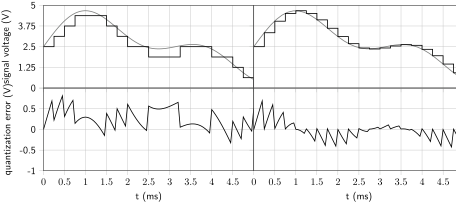
Quantization error refers to the difference between the actual and quantized voltage and is defined by (6.1.2).
\begin{equation}
\textrm{error} = V_{quantized} - V_{actual}\tag{6.1.2}
\end{equation}
Quantization error can be reduced by increasing the resolution of the ADC (as shown in Figure 6.1.3), or by increasing the sample rate (not shown in Figure 6.1.3).
Other types of error are possible in analog to digital converters and may depend on the architecture of the ADC. These will typically be listed in an ADC’s datasheet.
Subsection 6.1.3 Encoding
The encoding part of ADC comes when the sampled and quantized signal is then converted into a binary number. In hardware, this can be accomplished with a priority encoder.
The binary value stored by the ADC is given by (6.1.3), where \(V_{in}\) is the analog voltage input.
\begin{equation}
\textrm{ADC result} = 2^n \times \left(\frac{V_{in}}{V_{ref}}\right)\tag{6.1.3}
\end{equation}

