Section 12.1 Proportional Feedback Control
In proportional feedback control, the error is multiplied by a proportionality constant known as \(K_P\text{.}\) This term is then added to the process variable to create a new output, as defined by (12.1.1), where \(u(t)\) is the new output of the system. (Error was defined in (12.0.1).)
\begin{equation}
u(t) = y(t) + K_P e(t)\tag{12.1.1}
\end{equation}
In this manner, proportional control attempts to eliminate the current value of error that’s present in the system at any given time.
Proportional control error correction is depicted as a block diagram in Figure 12.1.1. The circle labeled \(\Sigma\) denotes the addition operation. Arrows pointing into the circle with a + sign will be added and arrows pointing into the circle with a − sign will be subtracted. Therefore, the block diagram depicts the process variable being subtracted from the setpoint. This is equal to the error. After being multiplied by the proportionality constant, that value is sent to the process, which generates a new process variable output.

If \(K_P\) is selected carefully, proportional control will lead to a self-correcting system. A process variable that is too large will generate a negative error term, subtracting from the new output sent to whatever device is being controlled. This will cause values that are too large to become smaller over time. A process variable that is too small will generate a positive error term, adding to the new output sent to whatever device is being controlled. This will cause values that are too small to become larger over time. If there is no error, then no changes will be made to the device that’s being controlled.
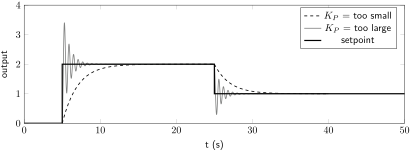
The proportionality constant \(K_P\) should be chosen with careful consideration. Values that are too low lead to sluggish, unresponsive feedback (this is known as an overdamped response). This is depicted in Figure 12.1.2 for a system with a setpoint given by the thick black line. The dashed gray output corresponds to an overdamped response. The output value takes a while to “catch up” to abrupt changes in the setpoint value.
Values of \(K_P\) that are too high become unstable and can oscillate rapidly between values (this is known as an underdamped response). This is depicted in Figure 12.1.2 for a system with a setpoint given by the thick black line. The solid gray output corresponds to an underdamped response. The value changes so quickly that it overshoots the desired value, then undershoots, then overshoots again before finally settling on the desired setpoint value. (Imagine how uncomfortable it would be for an automotive cruise control system to be underdamped!)