Section 9.6 ATmega328P Timer/Counter PWM Modes of Operation
The ATmega328P has three different configurable modes of generating pulse-width modulation (PWM) signals.
Subsection 9.6.1 Fast PWM
In fast PWM mode, the timer/counter increments from
BOTTOM to TOP, and then restarts again from BOTTOM. The period of a fast PWM signal is given by (9.6.1).
\begin{equation}
T_{fast PWM} = \frac{N \times (\texttt{TOP} + 1)}{f_{CLK,I/O}}\tag{9.6.1}
\end{equation}
This equation can be understood by looking at how the value stored in the
TCNTn register increments over time. Counting between zero and TOP requires TOP plus one intervals of time. This is depicted in Figure 9.6.1.
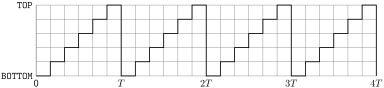
TOP +1 intervals of time to count between BOTTOM and TOP.Similar to the distinction between normal and CTC modes, fast PWM can either be configured to count to
MAX or to a different TOP value. These options are presented for each timer/counter in Table 9.6.2. (Note that these are also the same options used in phase-correct PWM mode, described in Subsection 9.6.2.)
TOP for each timer/counter in both fast PWM and phase-correct PWM modes.| Timer/counter 0 | Timer/counter 1 | Timer/counter 2 |
|---|---|---|
0xFF (MAX) |
0xFF (8-bit mode) |
0xFF (MAX) |
OCR0A |
0x1FF (9-bit mode) |
OCR2A |
0x3FF (10-bit mode) |
||
OCR1A |
||
ICR1 |
The timer/counter overflow flag (
TOVn) will be set each time the counter reaches TOP. This allows for the use of overflow interrupts in fast PWM mode. Output compare flags will be set each time the counter reaches the value stored in an output compare register. This allows for the use of output compare interrupts as well.
Typically, fast PWM is used to generate waveforms on one or more timer/counter output compare pin. When the compare output mode (
COMnx) bits are configured to cause the output compare pin(s) to operate in non-inverting mode, the output compare pin(s) will clear on a compare match and set when the timer/counter is reset to BOTTOM. (The opposite is true in inverting mode.)
If an exact frequency is desired, that cannot necessarily be generated by changing the prescaler and using
MAX, the value stored in OCRnA can be used as TOP to set a specific frequency. The output compare pin B can be used to generate the PWM waveform, with the duty cycle set by the value stored in the OCRnB register. The duty cycle in this case is defined by (9.6.2).
\begin{equation}
D_{OCnB} = \frac{\texttt{OCRnB}}{\texttt{OCRnA}}\tag{9.6.2}
\end{equation}
An example fast PWM waveform of this nature is shown in Figure 9.6.3.
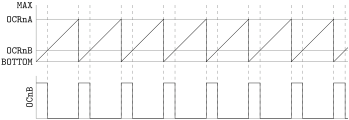
OCnB using OCRnA as TOP. The duty cycle is set by the value stored in OCRnB.When output compare register A (
OCRnA) is used as the value of TOP, output compare pin A (OCnA) cannot be used to generate a meaningful PWM waveform. This is because the pin is set every time there is a compare match, and cleared when the timer/counter resets to BOTTOM. However, if OCRnA is equal to TOP, then those two events occur simultaneously, and the value on OCnA will always be HIGH.
An exception to this is timer/counter 1, where value stored in
ICR1 can be used to define TOP. In this case, the frequency can be precisely tuned using the value of ICR1 and a prescaler. In addition, both output compare pins can have independent duty cycles configured by their corresponding output compare registers, defined by (9.6.3).
\begin{equation}
D_{OC1x} = \frac{\texttt{OCR1x}}{\texttt{ICR1}}\tag{9.6.3}
\end{equation}
If the frequency of the PWM waveform is not as strictly circumscribed, both output compare pins can be used to generate PWM signals in any timer/counter by using
MAX as the value of TOP. In timer/counter 1, MAX can be configured to operate in 8-bit mode, 9-bit mode, or 10-bit mode, as described in Table 9.6.2. Both output compare pins will have PWM waveforms of the same frequency, but each duty cycle can independently be configured by the corresponding output compare register, with a duty cycle defined by (9.6.4).
\begin{equation}
D_{OCnx} = \frac{\texttt{OCRnx}}{\texttt{MAX}}\tag{9.6.4}
\end{equation}
Regardless of the value of
TOP, when the value in the output compare register used to create the duty cycle of the wave is equal to BOTTOM, the output will be HIGH for one clock cycle. This can be considered to be a glitch, as the output would be expected to be LOW if the output compare register is equal to zero. This is depicted in Figure 9.6.4.
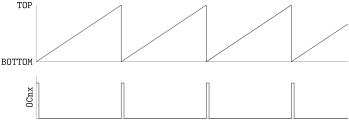
BOTTOM.Subsection 9.6.2 Phase-Correct PWM
In phase-correct PWM mode, the timer/counter increments from
BOTTOM to TOP, and then decrements back to BOTTOM. The timer/counter remains at TOP for one clock cycle. The frequency of a phase-correct PWM signal is defined by (9.6.5).
\begin{equation}
T_{phase-correct PWM} = \frac{2 \times N \times \texttt{TOP}}{f_{CLK,I/O}}\tag{9.6.5}
\end{equation}
This equation can be understood by looking at how the value stored in the
TCNTn register increments over time. Because the timer/counter only remains at TOP for one interval of time, it takes TOP plus one intervals of time to increment to TOP, but then TOP minus one intervals of time to decrement back to BOTTOM, for a total of 2×TOP intervals of time. This is depicted in Figure 9.6.5.
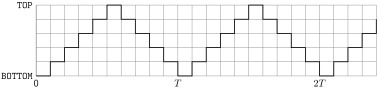
TOP intervals of time to increment from BOTTOM top TOP and then decrement back to BOTTOM.Phase-correct PWM can either be configured to count to
MAX or to a different TOP value. These options are given for each timer/counter in Table 9.6.2.
The timer/counter overflow flag (
TOVn) will be set each time the counter reaches BOTTOM. This allows for the use of overflow interrupts in phase-correct PWM mode. Output compare flags will be set each time the counter reaches the value stored in an output compare register. This allows for the use of output compare interrupts as well.
Phase-correct PWM can be used to generate waveforms on one or more timer/counter output compare pin. When the compare output mode (
COMnx) bits are configured to cause the output compare pin(s) to operate in non-inverting mode, the output compare pin(s) will clear on a compare match when incrementing and set on a compare match when decrementing. (The opposite is true in inverting mode.) This makes spikes or glitches in the output less likely (particularly in the case where the value of TOP is changed), and is preferred when operating hardware that can be sensitive to glitches (such as motors).
Similarly to fast PWM mode, if a specific frequency is required that necessitates the use of
OCRnA as TOP, then output compare pin B (OCnB) can be used to generate the PWM waveform, with the duty cycle set by the value stored in the OCRnB register. The duty cycle is defined in (9.6.2).
An example phase-correct PWM waveform of this nature is shown in Figure 9.6.6.
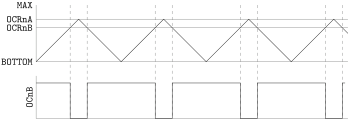
OCnB using OCRnA as TOP. The duty cycle is set by the value stored in OCRnB.When output compare register A (
OCRnA) is used as the value of TOP, output compare pin A (OCnA) cannot be used to generate a meaningful PWM waveform. This is because the pin is cleared on a compare match when incrementing, but set on a compare match when decrementing. However, these two events occur simultaneously, and the value on OCnA will always be HIGH.
An exception to this is timer/counter 1, where value stored in
ICR1 can be used to define TOP. In this case, the frequency can be precisely tuned using the value of ICR1 and a prescaler. In addition, both output compare pins can have independent duty cycles configured by their corresponding output compare registers, defined by (9.6.3).
If the frequency of the PWM waveform is not as strictly circumscribed, both output compare pins can be used to generate PWM signals in any timer/counter by using
MAX as the value of TOP. In timer/counter 1, MAX can be configured to operate in 8-bit mode, 9-bit mode, or 10-bit mode, as described in Table 9.6.2. Both output compare pins will have PWM waveforms of the same frequency, but each duty cycle can independently be configured by the corresponding output compare register, with a duty cycle defined by (9.6.4).
Unlike in fast PWM, there is no glitch that occurs in phase-correct PWM when the output compare register used to set the duty cycle is equal to
BOTTOM.
Subsection 9.6.3 Updating TOP Values
The value of
TOP can be modified in code; it does not need to be a fixed constant. This allows for the modification of the timer/counter frequency as the code executes. In order to prevent synchronization issues, the output compare A register is double buffered in PWM modes. This means that the CPU will write the new value of TOP to a buffer register and only update the value in OCRnA when a particular timing event occurs (either reaching the previous value of TOP or upon reaching BOTTOM).
This buffering does not occur in CTC mode (or in PWM modes on timer/counter 1 when
ICR1 is used to define TOP). If TOP is changed in CTC mode when the timer/counter to a value lower than the previous value of TOP and after the value in TCNTn has already become larger than the new value of TOP, then the timer/counter will increment to MAX (not TOP!) before the new value of TOP will take effect. This can be a particularly long interval of time when using timer/counter 1 and/or when using a large prescaler value.
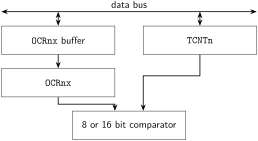
In fast PWM, writing to
OCRnA will write to the buffer register. The actual OCRnA register will only be updated the next time the counter reaches a value of TOP. A waveform depicting this phenomenon is shown in Figure 9.6.8. The output waveform is also shown, depicting the change in PWM frequency with changing values of OCRnA.
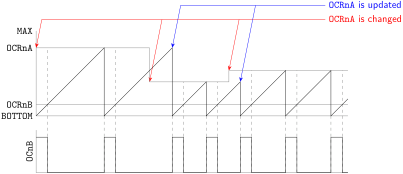
OCnB using OCRnA as TOP. The value of OCRnA is changed over time, but only updates when the value in the timer/counter becomes TOP and clears to zero.The same feature is present in phase-correct PWM. Changes to
OCRnA are only updated the next time the counter reaches a value of TOP. This is depicted in Figure 9.6.9.
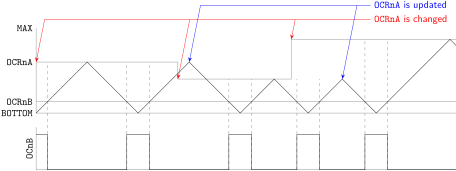
OCnB using OCRnA as TOP. The value of OCRnA is changed over time, but only updates when the value in the timer/counter becomes TOP.When using timer/counter 1, it is possible to use
ICR1 as the value of TOP. However, this register is not double buffered. This means that the value in the register will update immediately. In either PWM mode, if the updated value of ICR1 is lower than the previous value, the timer/counter will not make a compare match and will count to MAX (65,535) before beginning the next cycle. Once the next cycle begins, a compare match will occur as expected. However, one cycle of the waveform (or interrupt timing) will be significantly affected. This is depicted with phase-correct PWM in Figure 9.6.10. Because of this issue, it is recommended to use ICR1 only if the value of TOP will remain fixed.
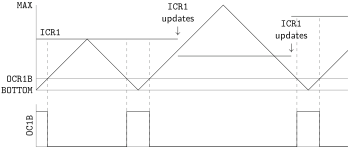
OC1B using ICR1 as TOP. The value of ICR1 is changed immediately, which may cause timing issues if the value of ICR1 is lower than the value stored in TCNT1.When the value of
TOP is changed in phase-correct PWM mode using OCRnA as TOP, even though the register is double buffered, there is still one issue that can occur when the value of OCRnA is changed. This issue is that waveforms are not completely symmetric about BOTTOM, which may be an issue when working with motors. This issue will be considered in the next section on phase- and frequency-correct PWM.
Subsection 9.6.4 Phase- and Frequency-Correct PWM
Phase- and frequency-correct PWM is much the same as phase-correct PWM, except that the output periods are all symmetrical. This is produced by updating the value of
OCRnA on BOTTOM, rather than on TOP. This PWM mode of operation is only available on timer/counter 1.
Because the only difference in operation regards how the value of
TOP updates, this mode of operation has the same frequency and duty cycle considerations as phase-correct PWM. The values available for TOP are given in Table 9.6.11.
TOP for timer/counter1 in phase- and frequency-correct PWM modes.| Timer/counter 0 | Timer/counter 1 | Timer/counter 2 |
|---|---|---|
| unavailable | OCR1A |
unavailable |
ICR1 |
Because of the problematic nature of
ICR1 not being double buffered (which was explained in Subsection 9.6.3), it is not recommended to use that register as the value for TOP when the value needs to be changed over time. Because this PWM mode of operation is designed to be used in the specific instance when TOP needs to change, it is strongly recommended that any designs using this PWM mode of operation use OCR1A instead of ICR1.
The issue of waveform asymmetry and symmetry is demonstrated in Figure 9.6.12, which depicts a phase-correct PWM signal (top) that is not symmetric around
BOTTOM. However, the phase- and frequency-correct PWM signal (bottom) is completely symmetric around BOTTOM.
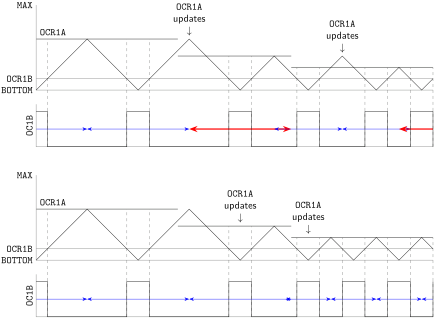
BOTTOM, but the phase- and frequency-correct PWM waveform is.If a symmetric waveform is required, and the value of
TOP can change over time, then it is recommended to use phase- and frequency-correct PWM counting to a TOP value of OCR1.

