Section 6.3 Digital to Analog Conversion
A digital to analog converter (DAC) performs the reverse function of an ADC by converting a binary value to an analog voltage. The analog voltage output of a DAC is given by (6.3.1), where \(n\) is equal to the resolution of the converter.
\begin{equation}
V_{out} = V_{ref} \times \left(\frac{\textrm{value}}{2^n}\right)\tag{6.3.1}
\end{equation}
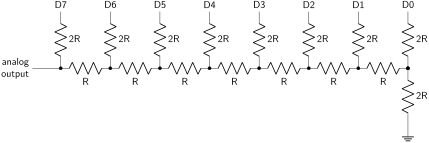
In a DAC circuit, a digital datastream can be sampled and held (or sampled continuously), in which case the digital value is then converted into an analog voltage level. An R-2R ladder is one of many common architectures used to convert a binary value into a voltage. The circuit diagram of a 3-bit R-2R ladder is shown in Figure 6.3.1.